
CHANGING LIVES AND TRANSFORMING LANDSCAPES



|
Roya Elghanian
USER INFO
HOMETOWN
London
NATIONALITY
Persian
Request a connection to {member's name}?
 
|
A connection request has been sent to {member's name}. |
|
|
Your message has been sent to {member's name}. |
Are you sure you would like to remove connection with <username>? 
|
BLOG ARCHIVE
▼ 2015 (2)
▼ November (1)
▼ February (1)
▼ 2014 (1)
▼ September (1)
▼ 2013 (2)
▼ 2012 (9)
▼ September (1)
▼ May (1)
▼ April (4)
The Truth About Water and some DIY Solutions
10 Reasons to Buy Fairtrade
How to Make Water Safe to Drink By Using Plastic Bottles and Sunlight
How to Build your own Tap in 9 Simple Steps
10 Reasons to Buy Fairtrade
How to Make Water Safe to Drink By Using Plastic Bottles and Sunlight
How to Build your own Tap in 9 Simple Steps
▼ March (1)
▼ February (1)
▼ January (1)
▼ 2011 (6)
▼ November (1)
▼ October (4)
▼ August (1)
TAGS
worldwide helpers
water sanitation, pur, proctar and gamble, worldwide helpers
worldwidehelpers
go green
water, wwh marketplace, clean water
fairtrade
practical answers
worldwide helpers, wwh, volunteer
worldwide helpers blog
oscars
conserve energy
volunteer
water sanitation
music for good, reverbnation
solution
build tap
SODIS
save planet
Volunteers
luci light, solar power light
Santa In the Streets 2001
Worldwide Helpers
Yasmin , sustainable development , fashion
facebook
save environment
non-profits
water related disease
Volunteer with Kids
How to Make Water Safe to Drink By Using Plastic Bottle
22 Apr 2012 | Tags: water sanitation; worldwidehelpers; SODIS | 0 comment
The problem
Fresh water is an increasingly scarce resource, even more so, access to clean, potable water for people is very limited. An estimated 1.1 billion people or one sixth of the world’s entire population lack a safe water.The lack of access to ‘good quality’ water leads to a greatly increased risk of contracting water-borne diseases, commonly diarrhoea, cholera, typhoid fever, hepatitis A, amoebic and bacillary dysentery. In developing countries water-borne diseases cause 15% of all child deaths (under the age of five).
There are a number of water treatment measures that can be adopted such as: storing water, boiling water, pasteurisatiion, filtration and chlorine. Thou these methods each have their limitations; either they are costly or do not completely cleanse the water.
There's a simple cost effective solution that can be adopted providing the sun is shining.
The Solution
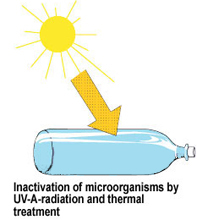
SODIS (Solar Water Disinfection) - a simple, low-cost and easily replicable solution to clean drinking water. SODIS works through a combination of heat and pathogen-killing Ultra Violet radiation (both through sunlight).
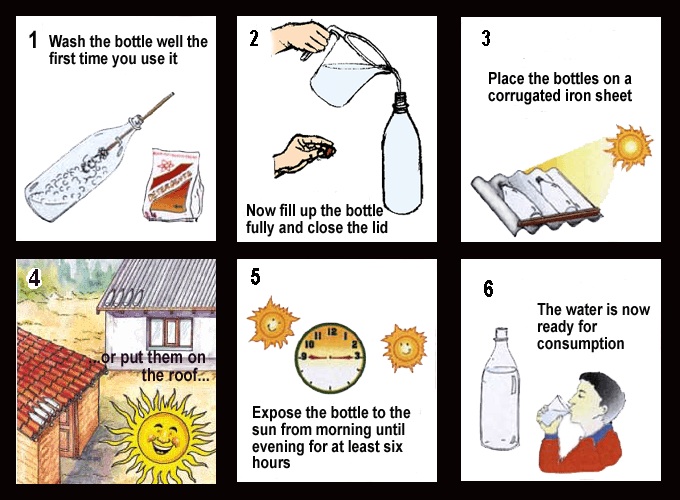
How to do it?
1. Check if the climate and weather conditions are suited for SODIS – basically there should be fairly bright weather with not more than 50% cloud cover.
2. Collect plastic PET (Poly Ethylene Terephthalate) bottles of one litre or 1-1/2 litre volume. PET is preferred to PVC, because PVC can contain harmful additives and to glass, because glass blocks out some of the UV rays.
3. Check if the screw cap is water tight and clean.
4. Fill bottles with water. Check if the water is clear enough. If there is a lot of discolouration and sediment, the water has to be pre-treated (filtered) before SODIS.
5. Lay bottles out on a suitable heat-reflecting surface – roofing sheets, CGI (Corrugated Iron) sheets etc, in a clear spot on the roof or garden.
6. Expose bottles to direct sunlight for at least six hours.
7. After 6 hours water is clean and safe to drink.
How successful is SODIS?
SODIS is 99.9% effective against pathogenic micro-organisms found in water. This may not be as good as boiling which provides pathogen-free sterile water or even pasteurisation. But, in terms of cost, affordability, simplicity and sustainability, SODIS scores over these other methods.
SODIS reduces the incidence of infectious diarrhoea, dysentery, and also protects against cholera.
Which micro-organisms is SODIS effective against?
The sun’s radiation is proven to be deadly to human pathogens, which are used to living in the moist, humid, dark environment inside the body. Once they are discharged into the wider environment, these pathogens are extremely sensitive to conditions outside. UV radiation can be fatal to many such pathogens, while others are inactivated by maintaining a 50-57 ̊C heat in the bottle for a given period of time.

0 comment


Share with connections

Share on social platforms
|
MENU
OPPORTUNITIES
WWH UK Registered Charity No.: 1117253