



|
Organization Of African Youth - Cameroon
USER INFO
SECTOR
Community
COUNTRY
Cameroon
Request a connection to {member's name}?
 
|
A connection request has been sent to {member's name}. |
|
|
Your message has been sent to {member's name}. |
Are you sure you would like to remove connection with <username>? 
|
BLOG ARCHIVE
▼ 2014 (1)
▼ June (1)
Human Rights Festival "Combatting Sexual Violence in Schools"
▼ 2012 (2)
Human Rights Festival "Combatting Sexual Violence
26 May 2014 | Tags: Human Rights festival, Cameroon, Sexual violence, GBV | 0 comment
This blog is about the Human Rights Festival that was organized to mark the end of 16 Days Activism against Gender Based Violence as well as to celebrate International Human Rights Day.
The '16 days of activism against gender based violence against women’ is a worldwide campaign that provides an opportunity to take a stand against gender-based violence and to mobilize around women’s human rights. The 16 Days Campaign has been used as an organizing strategy by individuals and groups around the world to call for the elimination of all forms of violence against women by:
• raising awareness about gender-based violence as a human rights issue at the local, national, regional and international levels
• strengthening local work around violence against women
• establishing a clear link between local and international work to end violence against women
• providing a forum in which organizers can develop and share new and effective strategies
• demonstrating the solidarity of women around the world organizing against violence against women
• creating tools to pressure governments to implement promises made to eliminate violence against women
Organization of African Youth – Cameroon with sponsorship from Alert Fond and Haella Stichting and material support from Plan Cameroon, hosted an open discussion which took place at the Bilingual Grammar School Gymnasium and was attended by students, teachers, municipal Authorities and other civil society organizations. Students came from Bilingual Grammar School Molyko, Buea, Government Technical High School Molyko, Buea, St. Therese International Comprehensive College Molyko, Buea, Presbyterian Comprehensive College Buea.
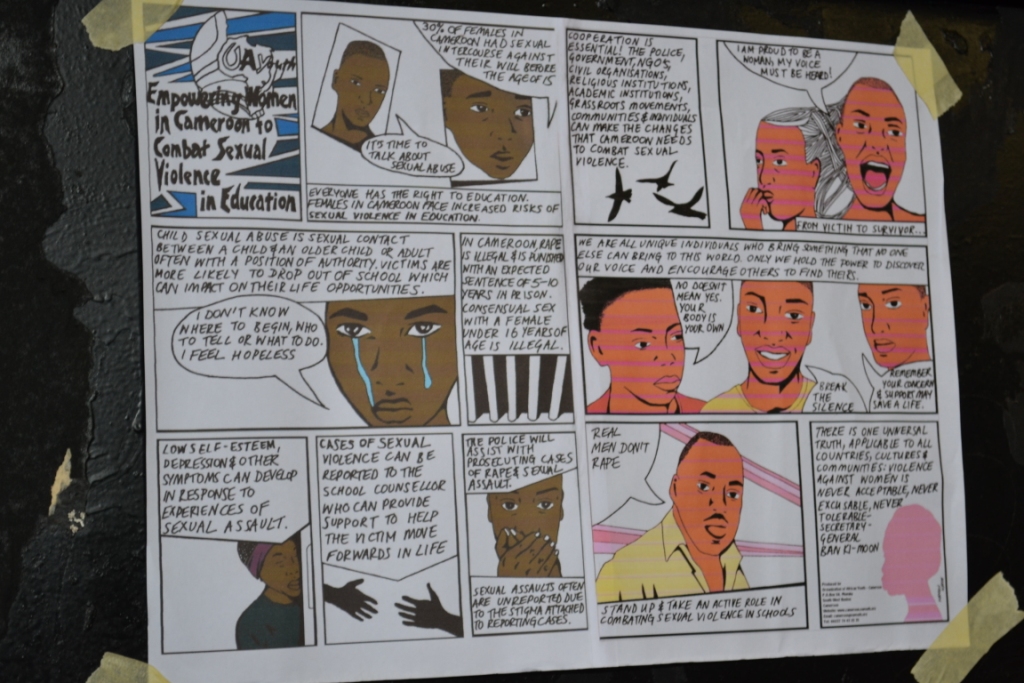
More specifically, the objective of this open discussion was to
• raise awareness about gender-based violence as a human rights issue in our schools
• Engaging the girls in civic activities
• The role of leadership in combating violence against women
The open discussions started with an opening address from the Rapporteur from the Regional Office of the National Commission of Human Rights and Freedom, Buea, South West Region. He dwelled on identifying and dealing with violence in school environment. This discussion was focused on introducing Human Rights to the participants. The 30 Human Rights was explained to the participants as well as their responsibilities towards the respect of these rights. This was followed by talks on sexual violence during which time students raised their concerns and their views on sexual violence and it’s manifestation in the school environment as well as action that can be taken by students, teachers, counselors and school administration.
The Power of Leadership in Enforcing Human Rights Presented by Yonga Nelly Shella, Coordinator – Rural Women Development Center, BUEA. Miss Yonga Nelly, Commonwealth Youth Worker awardee and a student shared their experiences. Her presentation defined a leader, gave an example of one she considers a leader, sited the qualities of a good leader and concluded by talking on the roles leaders can play in enforcing human rights.
One of the aspects of her definition termed a leader as one whose action sets a pace for change. This was directly linked with the story of Malala who believed that education is primordial component in girls’ life and is setting the pace to make sure that this comes true in her country. She highlighted some key qualities of a good leader as: Honesty and integrity, Motivate and inspire others, Positive attitude, Fighter, Confident, Committed, be a peoples people, Creative, Visionary, Work with and appreciate others and be a servant.
She concluded with some roles which a leader plays to enforce human rights such as;
- Restore dignity and worth to your group members
- Define fair rules, that take into consideration the United Nation Declaration of Human Rights
- Be a servant than a boss
- Create an enabling environment
- Safe guard the interest of your group
- Communicate peace, love and justice, through you attitude and action
- Treat all with respect, give room for participation and contributions
- Regard and treat all as equals
Human Rights and Civic Engagement: A Focus on Citizens' Duties Presented by Ongbile Yoko Nadege
This presentation advised attendees on the necessity of taking action within their community. It was aimed at raising awareness on the fulfillment of our civic duties. She defined Civic education or engagement as the duties of every citizen towards his or her nation. Throughout the presentation a special attention was given to two main duties namely:
- The duty to keep the environment clean
- The duty to participate in community-development
She emphasized on the fact that Cameroonian youth believe that keeping their environment clean is not their responsibility but that of HYSACAM, the state agency in charge of cleaning streets in the country. She called on the youths to be active citizens making sure that they cater for their environment by avoiding litter as well as cleaning rubbish beginning from their own surroundings and not constantly waiting for HYSACAM.
The second main duty the presentation emphasized was the duty to participate, especially in the socio-political life of the community. She had observed that in many developmental activities within the country, there is lesser youth involvement. She therefore recommended that, to bring about development in our country and community in particular, it is important to impact ones country positively in one way or the other. It doesn’t matter how small what matters is that you are conscious of what you should and are doing it.
The open discussion ended with questions and answers from attendees and facilitators on how they can get involved as students and where to go to in cases of violence. A closing remark from the Country Coordinator of Organization Of African Youths – Cameroon, Mr. Jude Thaddeus who called on the collective efforts of the attendees in playing their part in eliminating violence against women.
The '16 days of activism against gender based violence against women’ is a worldwide campaign that provides an opportunity to take a stand against gender-based violence and to mobilize around women’s human rights. The 16 Days Campaign has been used as an organizing strategy by individuals and groups around the world to call for the elimination of all forms of violence against women by:
• raising awareness about gender-based violence as a human rights issue at the local, national, regional and international levels
• strengthening local work around violence against women
• establishing a clear link between local and international work to end violence against women
• providing a forum in which organizers can develop and share new and effective strategies
• demonstrating the solidarity of women around the world organizing against violence against women
• creating tools to pressure governments to implement promises made to eliminate violence against women
Organization of African Youth – Cameroon with sponsorship from Alert Fond and Haella Stichting and material support from Plan Cameroon, hosted an open discussion which took place at the Bilingual Grammar School Gymnasium and was attended by students, teachers, municipal Authorities and other civil society organizations. Students came from Bilingual Grammar School Molyko, Buea, Government Technical High School Molyko, Buea, St. Therese International Comprehensive College Molyko, Buea, Presbyterian Comprehensive College Buea.
More specifically, the objective of this open discussion was to
• raise awareness about gender-based violence as a human rights issue in our schools
• Engaging the girls in civic activities
• The role of leadership in combating violence against women
The open discussions started with an opening address from the Rapporteur from the Regional Office of the National Commission of Human Rights and Freedom, Buea, South West Region. He dwelled on identifying and dealing with violence in school environment. This discussion was focused on introducing Human Rights to the participants. The 30 Human Rights was explained to the participants as well as their responsibilities towards the respect of these rights. This was followed by talks on sexual violence during which time students raised their concerns and their views on sexual violence and it’s manifestation in the school environment as well as action that can be taken by students, teachers, counselors and school administration.
The Power of Leadership in Enforcing Human Rights Presented by Yonga Nelly Shella, Coordinator – Rural Women Development Center, BUEA. Miss Yonga Nelly, Commonwealth Youth Worker awardee and a student shared their experiences. Her presentation defined a leader, gave an example of one she considers a leader, sited the qualities of a good leader and concluded by talking on the roles leaders can play in enforcing human rights.
One of the aspects of her definition termed a leader as one whose action sets a pace for change. This was directly linked with the story of Malala who believed that education is primordial component in girls’ life and is setting the pace to make sure that this comes true in her country. She highlighted some key qualities of a good leader as: Honesty and integrity, Motivate and inspire others, Positive attitude, Fighter, Confident, Committed, be a peoples people, Creative, Visionary, Work with and appreciate others and be a servant.
She concluded with some roles which a leader plays to enforce human rights such as;
- Restore dignity and worth to your group members
- Define fair rules, that take into consideration the United Nation Declaration of Human Rights
- Be a servant than a boss
- Create an enabling environment
- Safe guard the interest of your group
- Communicate peace, love and justice, through you attitude and action
- Treat all with respect, give room for participation and contributions
- Regard and treat all as equals
Human Rights and Civic Engagement: A Focus on Citizens' Duties Presented by Ongbile Yoko Nadege
This presentation advised attendees on the necessity of taking action within their community. It was aimed at raising awareness on the fulfillment of our civic duties. She defined Civic education or engagement as the duties of every citizen towards his or her nation. Throughout the presentation a special attention was given to two main duties namely:
- The duty to keep the environment clean
- The duty to participate in community-development
She emphasized on the fact that Cameroonian youth believe that keeping their environment clean is not their responsibility but that of HYSACAM, the state agency in charge of cleaning streets in the country. She called on the youths to be active citizens making sure that they cater for their environment by avoiding litter as well as cleaning rubbish beginning from their own surroundings and not constantly waiting for HYSACAM.
The second main duty the presentation emphasized was the duty to participate, especially in the socio-political life of the community. She had observed that in many developmental activities within the country, there is lesser youth involvement. She therefore recommended that, to bring about development in our country and community in particular, it is important to impact ones country positively in one way or the other. It doesn’t matter how small what matters is that you are conscious of what you should and are doing it.
The open discussion ended with questions and answers from attendees and facilitators on how they can get involved as students and where to go to in cases of violence. A closing remark from the Country Coordinator of Organization Of African Youths – Cameroon, Mr. Jude Thaddeus who called on the collective efforts of the attendees in playing their part in eliminating violence against women.

0 comment


Share with connections

Share on social platforms
|
MENU
OPPORTUNITIES
WWH UK Registered Charity No.: 1117253